Oregon

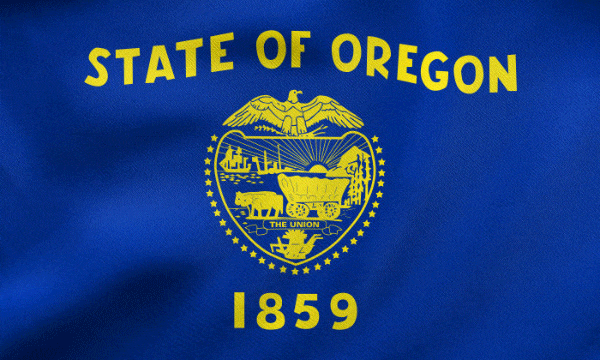
Oregon State Information
Official Name: State of Oregon
Organized as a territory/republic: August 14, 1848
Entered Union (rank): February 14, 1859 (33rd state)
Present constitution adopted: 1859
State abbreviation/Postal code: Ore./OR
State Area Code: 503, 541, 971, 458
Fun Facts About Oregon
Nickname: Beaver State
Origin of name: Unknown. However, it is generally accepted that the name, first used by Jonathan Carver in 1778, was taken from the writings of Maj. Robert Rogers, an English army officer.
Motto: “Alis Volat Propriis” (“She flies with her own wings”) (1987)
Slogan: "We Like It Here. You Might Too."
Flower: Oregon grape (1899)
Tree: Douglas fir (1939)
Animal: Beaver (1969)
Bird: Western meadowlark (1927)
Fish: Chinook salmon (1961)
Gem: Sunstone (1987)
Colors: Navy blue and gold (1959)
Song: “Oregon, My Oregon” (1927)
Fossil: Metasequoia (2005)
Insect: Oregon swallowtail (1979)
Rock: Thunderegg (1965)
Dance: Square dance (1977)
Seashell: Oregon hairy triton (1991)
Beverage: Milk (1997)
Mushroom: Pacific golden chanterelle (1999)
Government
Governor: Tina Kotek (to Jan. 2027)
Secretary of State: Cheryl Myers (to Jan. 2025)
General Treasurer: Tobias Read (to Jan. 2025)
Atty. General: Ellen Rosenblum (to Jan. 2025)
Senators: Ron Wyden, D (to Jan. 2029); Jeff Merkley, D (to Jan. 2027).
Historical biographies of Congressional members
State website: https://www.oregon.gov/
Population
Residents: Oregonian
Resident population: 4,240,137 (17th Largest State, 2022)
10 largest cities (2002 est.): Portland, 635,067; Eugene, 177,923; Salem, 177, 487; Gresham, 111,621; Hillsboro, 107,299; Bend, 103,254; Beaverton, 97,053; Medford, 85,556; Springfield, 61,400; Corvallis, 60,956.
Race/Ethnicity: White (74.1%); Hispanic or Latino (14%); Asian (5%); Two or More Races (4.2%); Black or African American (2.3%); American Indian or Alaska Native (1.9%); Native Hawaiian or Other Pacific Islander (0.5%).
Religion: Unaffiliated (31%); Evangelical Protestant (20%); Mainline Protestant (13%); Catholic (12%); Mormon (4%); Other faiths (3%); Jewish (2%); Muslim (1%); Orthodox Christian (1%); Historically Black Protestant (1%).
Sex: Male (49.9%); Female (50.1%)
Age: Under 18 (25.3%); 18-64 (56.1%); 65 and over (18.6%). Median Age: 39.5
Economy
GDP: 229.5 billion dollars (25th in the U.S., 2022)
Unemployment: 3.7% (2023)
Geography
Land area: 98,381 sq mi (254,806 km2)
Geographic center: In Crook Co., 25 mi. SSE of Prineville
Number of counties: 36
Largest county by population and area: Multnomah, 795,083 (2022); Harney, 10,226 sq mi.
State parks/recreation areas: 255
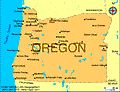
Oregon, a constituent state of the United States, joined the Union on February 14, 1895, as the 33rd state. It is bordered to the north by Washington State, the east by Idaho, the south by California and Nevada, and the west by the Pacific Ocean. Salem is the capital.
The state is defined by its physical diversity, which includes rainforests, mountains, valleys, and eastern deserts. Several bodies of water, including the Columbia River, Willamette River, and the Pacific Ocean shape the state’s climate and economic history. The western climate of the state is largely influenced by the Pacific Ocean, which creates a mild climate, while the eastern portion of the state experiences a colder, wetter climate.
Nearly half of the state is covered in forests, leading to a diverse population of animals and plants inhabiting the state. Additionally, forestry has been an important economic sector since the state’s founding.
Oregon has a reputation as a progressive state that embraces its natural resources and actively works to protect them. The state is a diverse and naturally beautiful place to visit or live.
Oregon Geography
Oregon spans 295 miles north to south at its longest point, and 395 miles east to west at its widest, with a total area of 98,381 square miles (254,810 km2). It is the ninth-largest state in the United States. The highest point is Mount Hood, at 11,249 feet (3,429 m), and its lowest point is at sea level of the Pacific Ocean along the Pacific coast. Crater Lake National Park is the site of the deepest lake in the United States at 1,943 feet (592 m).
The mountains in western Oregon are home to three of the most prominent mountain peaks in the United States. These mountains were formed by volcanic activity. The Columbia River, which forms most of Oregon’s northern border with Washington, played an important role in the state’s geographic and cultural history. About 15,000 years ago, the Columbia River frequently flooded, depositing fertile soil in the Willamette Valley.
The landscape varies greatly across the state and includes rain forest in the Coast Range to barren deserts in the southeast. Central Oregon features high desert and volcanic rock, as well as the Oregon Badlands Wilderness. Roughly 60% of Oregon is covered in forest.
Oregon is home to a variety of flora and fauna, including the Douglas fir, redwood, ponderosa pine, western red cedar, and hemlock. Oregon is the top timber producer of the lower 48 states. Common animals include a variety of mice and rats, beavers, porcupines, wolves, focus, and antelopes. The Pacific coast has seals, sea lions, humpback whales, killer whales, bottlenose dolphins, and Pacific white-sided dolphins. Notable birds include American widgeons, mallard ducks, great blue herons, and a variety of owls and sparrows.
Overall, the climate of Oregon is generally mild and varies across the state. The western region has an oceanic climate, resulting in very wet winters, moderately to very wet spring and fall seasons, and dry summers. The southwestern region experiences drier and sunnier winters and hotter summers. Most of eastern Oregon, which is largely high desert, experiences cold, snowy winters and very dry summers. Most of the state experiences significant snowfall, but the Willamette Valley has milder winters compared to the remainder of the state.
Oregon has one National Park, Crater Lake National Park, two National Monuments, John Day Fossil Beds, and Oregon Caves. The federal government owns approximately 53% of Oregon’s land.
Oregon People & Population
The U. S. Census Bureau estimates the 2022 population to be 4,240,137, making Oregon the 17th most populated state. Oregon has seen a decrease in its population of non-Hispanic Whites over the last 50 years. In 1970, 95.8% of the population was non-Hispanic White, while the 2020 census listed 74.1% of the population as non-Hispanic White. The fastest-growing demographic is people of Hispanic or Latino descent, making up 14% of the population. Foreign-born persons represented 9.8% of citizens.
According to a Pew Research Center survey, 61% of Oregonians identified as Christian, with Evangelical Protestants, Mainline Protestants, and Catholics making up the majority. 31% identified as being unaffiliated.
Portland is Oregon’s most populous city, with a population of 635,067. 60% of the population lives in the Portland metropolitan area in the northwest region of the state. Eugene and Salem are the next largest cities. Salem, the state capital, is one of the nation’s top food-processing centers. The Roma, who first reached the state in the 1890s, have a substantial population in the Willamette Valley and Portland.
Estimates place the median household income in 2021 dollars at $70,084, and the per capita income at $37,816. A U.S. News and World Report survey ranked Oregon as the 23rd best state to live in. While the state ranked number two in infrastructure, its youth crime rates were above the national average, graduation rates were below the national average, and the state exceeded the national average in several domains. According to the Housing and Urban Development Department’s 2022 Annual Homeless Assessment Report, an estimated 17,959 homeless people were living in Oregon.
There were 301 police officers for every 100,000 people, ranking the state behind Utah for the fewest law enforcement officers per capita.
The Oregon Department of Education oversees all public education in the state. In 2022, 81.3% of Oregon high schoolers graduated from high school in four years. This was a slight increase over the previous year’s rate. The Higher Education Coordinating Commission oversees all higher education. Oregon has 17 public community colleges, 7 public universities, and many private colleges and universities. Oregon State University is the largest public university in the state of Oregon.
Oregon offers a state Medicaid managed care plan for citizens who qualify, offering health care coverage to those who may not otherwise qualify. While the program is known for offering innovative programs, it has come under scrutiny from lawmakers and the public for failing to meet funding goals and limiting enrollment throughout its history.
Oregon Government
The Oregon state capitol, Salem, is home to the state government. The government consists of three branches: the legislative branch, the executive branch, and the judicial branch. The state also has a system of commissions. In this system, private citizens are appointed by the governor and confirmed by the Senate. The commissions have the authority to hire and fire the heads of the agencies they govern and confirm rule changes.
The governor leads the executive branch. The current governors, Tina Kotek, and Maura Healey of Massachusetts made history in 2022 by becoming the first openly lesbian governors in United States history. Oregon is one of a handful of states that does not have a lieutenant governor. The governor is responsible for executing the laws, making recommendations to the Oregon legislature, and transacting all necessary business of the state government.
Oregon’s secretary of state is the second most powerful person in the executive branch. They are responsible for running the state’s elections, auditing public agencies, maintaining public records, and helping to manage state lands. In the Oregon state government, if the governor vacates their seat or dies before the end of the term, an elected secretary of state will fill the role.
The Oregon state legislature is called the Oregon Legislative Agenda and consists of a Senate and a House of Representatives. 60 House members serve two-year terms. Democrats have consistently held a majority of seats in the House, except in 2011-2012, when the seats were equally split between Republicans and Democrats, and 2005-2006, when Republicans held a majority. 30 state Senators serve in four-year terms. Democrats have held a majority of the seats since 2010.
The legislature is responsible for finalizing biennial budgets. For 2021-2023, the state budget planned expenditures of $25.447 billion in General Funds, $1.363 billion in Lottery Funds, $48.568 billion in Other Funds, and $27.411 billion in Federal Funds, totaling $112.8 billion.
The Judicial Branch is led by the Oregon Judicial Department, which oversees four state-run court systems: The Oregon Supreme Court, the Tax Court (includes the trial and appellate courts), the Oregon Circuit Courts (trial courts for criminal and civil proceedings), and the Court of Appeals (handles appeals from the Circuit Court and Local Courts). The judicial branch is largely responsible for hearing any criminal or civil cases, while the Supreme Court settles appeals cases or compliance against the state and federal constitutions.
Oregon has many state agencies that oversee specialized aspects of public services. These include:
-
Oregon Office of Degree Authorization
-
Oregon Department of Fish and Wildlife
-
Oregon State Library
-
Oregon Liquor Control Commission
-
Oregon Lottery
-
Oregon Parks and Recreation
-
Oregon State Police
-
Oregon Department of Transportation
-
Oregon Higher Education Coordinating Commission
-
Oregon Office of University Coordination
Political affiliation is split between eastern and western Oregon. Eastern Oregon, which is more rural, tends to vote for Republican candidates, while Western Oregon tends to vote for Democratic candidates. The larger population in the west tilts Oregon in favor of Democratic candidates in federal elections. Oregon Democrats consistently rank as some of the nation’s most liberal voters.
Oregon has a graduated individual tax which ranges from 4.75%-9.90%. There is no state sales tax in Oregon. The constitution includes a “kicker” that caps tax revenue limits. When the total tax revenue exceeds the limit by more than two percent, the excess must be returned to taxpayers.
The state constitution is the governing document for the state. The Oregon Revised Statutes are the codified laws that exist in the state. Oregon has an initiative system by which citizens can introduce and approve laws and amendments to the Constitution.
Local governments are organized into counties, regional, metro, and city governments. Each section is responsible for different public services. Large city governments have an elected city council that hires a manager or administrator who is responsible for daily city affairs while smaller cities have a mayor/council format, in which all positions are elected.
Oregon Economy
Oregon’s economy has largely centered around its natural resources. Traditionally, logging, agriculture, and fishing have been the largest industries. In the late 20th and early 21st centuries, manufacturing and tourism have come to significantly contribute to the economy. In 2022, Oregon’s economy ranked 25th in the United States, bringing in 229.5 billion dollars. As of April 2023, the unemployment rate was 3.7%.
Livestock products comprise one-third of the state’s total agricultural trade commodity value, followed by dairy and poultry. Wheat, potatoes, barley, pears, apples, and wine grapes are also large contributors. Oregon is among the top states in producing hazelnuts, peppermint, raspberries, blackberries, and loganberries.
Nearly 60% of state land produces or is capable of producing commercial timber. Since 1938, Oregon has led the country in softwood lumber production. State agencies own about half of the state’s forests. The Oregon Forest Practices Act of 1971 was the first law in the country to require that natural resources be protected during logging operations.
Forest product manufacturing accounted for about one-third of Oregon’s economic output at the end of the 20th century. In the late 20th century, high-technology industries became the largest industry. Most metals-related industries and high-technology industries are located in the Portland metropolitan area and the greater Willamette Valley. Nike has been located in Oregon since the 1970s.
Tourism is another major component of Oregon’s economy. Mount Hood National Forest, Crater Lake National Park, and the Columbia River Gorge National Scenic Area draw tourists to experience the state's varied and beautiful natural environment. Other recreational opportunities include hiking, fishing, skills, and windsurfing.
Oregon Interesting Facts
Oregon is well known for its natural beauty and diverse landscapes, progressive politics, and the cultural impact of the Oregon Trail. While still a young state, Oregon has a strong reputation for being a land of natural wonder and beauty at the heart of America’s frontier history.
The Natural Landscape
Like most western states, the federal government owns a large portion of Oregon’s land. The National Parks Services and Bureau of Land Management oversee much of the federal land. Outside of federal land, Oregon has 225 state parks.
One of the most popular tourist destinations is Crater Lake National Park. Hood River is known as the windsurfing capital of the world. Strong winds and large waves make it a perfect recreation area for water and land sports, with great hiking trails and scenic landscapes. Cannon Beach boasts Haystack Rock, the third-largest intertidal structure in the world. The Columbia River Gorge is home to Multnomah Falls, another natural wonder and top tourist destination.
Oregon’s coast is another popular tourist destination, boasting varied beachscapes, small towns on the 101 highway, and views no matter when you visit.
Progressive Politics
Nationally, the state of Oregon is known for its progressive politics and laws. It was the first state to pass a law legalizing physician-assisted suicide, was one of the first states to decriminalize cannabis (1973) and legalize it for recreational use (2014), and in 2020 became the first state to approve the use of psilocybin for personal use for people over 21 years of age.
The state also has some of the strictest environmental protection and land use laws in the nation. These laws are meant to address environmental damage through pollution and deforestation and protect the state’s forests.
In 2023, the state enacted a new family leave act meant to protect employees' positions and offer paid leave in certain circumstances. In 2020, the state decriminalized possession of cocaine, heroin, LSD, methamphetamine, and oxycodone, making it the first state in the country to implement such a policy.
The Oregon Trail
The Oregon Trail isn’t just a famous computer game. The trail was a 2,170-mile-long wagon route from Missouri to Oregon that emigrants used to move west in the mid-1800s. Fur trappers laid the trail from about 1811 through 1840. In 1836, the first wagon train left Independence, Missouri for Oregon. When they arrived, the trail earned its name.
Passage through the Rocky Mountains and other terrain in the American Midwest made the journey dangerous for many settlers. The beginning of the Oregon Trail connected to the California Trail, Mormon Trail, and Bozeman Trail. About 400,000 travelers used the trail from 1836-1869 after the completion of the transcontinental railroad.
Oregon History
The land of Oregon has been occupied for thousands of years by Native American peoples. Although European explorers had been aware of the land of Oregon since the mid-16th century, it wasn’t until the late 1700s that Europeans began exploring and trading in Oregon. The Oregon territory was organized on August 14, 1848, and became the 33rd state on February 14, 1859. Oregon has played a significant role in American expansionism and continues to be a vital component of the American story.
Pre-Colonial History
Evidence found at Fort Rock Cave and the Paisley Caves suggests that Oregon has been inhabited for at least 15,000 years. Little is known about these inhabitants, but by 8,000 BC, there is significant evidence of settlements throughout the state. Most settlements were concentrated along the lower Columbia River, in the western valleys, and around the coast. By the 16th century, many Native American groups including the Chinook, Coquille, Bannock, Nez Perce, Shasta, and Klamath called Oregon home.
Colonial History
The land of Oregon remained largely unexplored by Europeans for several centuries. Explorers Juan Rodriguez Cabrillo, Francis Drake, Martin de Aguilar, Juan Jose Perez Hernandez, and James Cook are all reported to have docked at or explored the coast of Oregon over a nearly 230-year period, but it wasn’t until the late 18th and early 19th centuries that Oregon would be explored.
The Lewis and Clark Expedition reached the mouth of the Columbia River in 1805. The British Fur Company, the Hudson’s Bay Company, and the North West Company tried to lay claim to the land of Oregon. These companies would dominate the region for the next few decades.
Pre-Civil War History
Early American migration to the Pacific Coast began in the 1830s. Methodist missionaries established the first permanent settlement in the Willamette River Valley in 1834. Migration via the Oregon Trail began in the 1840s. American settlers organized a provisional government in the early 1840s. In 1844, the English moved their fur companies out of the region to settle further north in Victoria, British Columbia. Oregon became a territory in 1846.
In the years before the American Civil War, an influx of Free Staters migrated to the territory, leading to political tensions. In 1853, the Washington Territory was established north of the Columbia River. Oregon law forbade African Americans from settling in the territory while the Washington Territory allowed African American migration.
Oregon achieved statehood in 1859.
Post-Civil War History
Following conflicts between settlers and Native Americans, by 1883, most Oregon Native Americans were relocated to reservations. The same year, construction on a railroad began, connecting Oregon to the rest of the country, greatly expanding the population and improving the economic prospects in the state.
At the turn of the 20th century, two-thirds of Oregon’s population lived in rural areas and practiced agriculture and forestry. Soon, the cities expanded due to an increase in industrial and manufacturing jobs. By the early 21st century, nearly 75% of the population lived in urban areas.
Modern History
In the 1970s, the Pacific Northwest was particularly hard hit by the 1973 oil crisis, and Oregon experienced a significant shortage. To combat litter, the Oregon Beverage Container Act of 1971, or the Bottle Bill, was meant to encourage recycling by reimbursing people for recycling bottles for a small sum.
The state’s rapid growth led to pollution, congestion, and the need for improved infrastructure. State leaders sought out innovative solutions to these problems to protect the environment and control land use, resulting in the diversification of the economy. Oregon is a leader in biotechnology high-technology manufacturing and aquaculture.
People Also Ask…
That’s everything you need to know about Oregon but how well do you know the other U.S. states during the Civil War? Test yourself with Infoplease The Confederate States of America Quiz today!
Is Oregon a Good Place To Live?
Oregon ranks number 23 for the best states to live on the U.S. World and News Report survey. According to the survey, it ranks highest in infrastructure and natural environment, with low rankings in crime and corrections, and education. The state poverty rating of 12.2% is above the national average of 11.6%.
What Is Oregon Mostly Known For?
Oregon state is most well known for its diverse landscape and outdoor recreational activities. Several National Parks and Monuments attract tourists from all over the world. There are countless hiking, biking, and lakes to explore. Additionally, Portland is one of the state’s top tourist destinations due to its funky vibe, abundance of microbreweries, and unique art and music scene.
What Is the State Tax in Oregon?
Oregon does not have a state sales tax. The state has a graduated individual income tax that ranges from 4.75% to 9.90%. Some jurisdictions collect local income taxes. The corporate tax rate ranges from 6.60%-7.60%. Property taxes are below the national average at 0.82%.
See more on Oregon:
Encyclopedia: Oregon
Encyclopedia: Geography
Encyclopedia: Economy
Encyclopedia: Government
Encyclopedia: History
Monthly Temperature Extremes
Selected famous natives and residents:
- James Beard food expert;
- Raymond Carver writer and poet;
- Homer C. Davenport political cartoonist;
- David Douglas botanist;
- Abigail Scott Duniway women's suffrage advocate;
- John E. Frohnmeyer former chairman of the National Endowment for the Arts;
- Robert Gray sea captain and discoverer of Columbia River;
- Matt Groening cartoonist;
- Mark Hatfield senator;
- Donald P. Hodel secretary of the Interior;
- Chief Joseph Nez Percé chief;
- Dave Kingman baseball player;
- Ursula LeGuin writer;
- Courtney Love musician, singer, actor;
- Edwin Markham poet;
- Phyllis McGinley author;
- Linus Pauling chemist;
- River Phoenix actor;
- Jane Powell actor and singer;
- John Reed poet and author;
- Harvey W. Scott editor;
- Doc Severinsen band leader;
- Norton Simon business executive;
- Paul M. Simon Illinois senator;
- William E. Stafford poet;
- Sally Struthers actor;
- Corin Tucker musician, singer.
Trending
Here are the facts and trivia that people are buzzing about.