Colombia | Facts & Information

- Colombia Profile
- History
- News and Current Events
Infoplease has everything you need to know about Colombia. Check out our country profile, full of essential information about Colombia's geography, history, government, economy, population, culture, religion and languages. If that's not enough, click over to our collection of world maps and flags.
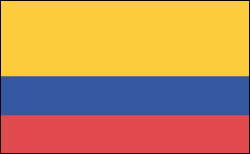
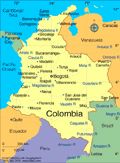
Facts & Figures
-
Official name: Republic of Colombia (República de Colombia)
Land area: 401,042 sq mi (1,038,699 sq km)
Total area: 439,736 sq mi (1,138,910 sq km)
President: Ivan Duque (2018)
Vice President: Marta Lucia Ramirez Blanco (2018)
Population (2022 est.): 49,059,221 (growth rate: .59%); birth rate: 15.21/1000; infant mortality rate: 11.65/1000; life expectancy: 74.89
Capital and largest city (2022 est.): Santafé de Bogotá, 11.344 million
Other large cities: Medellín, 4.068 million; Cali, 2.837 million; Barranquilla, 2.325 million; Bucaramanga, 1.366 million, Cartagena, 1.079 million (2018)
Currency: Colombian Peso
National Holiday: Independence Day (7/20)
Nationality/Demonym: Colombian (Colombiano/a)
Languages: Spanish (official) 99.2%
Ethnicity/race: Mestizo and White 87.6%, Afro-Colombian (includes Mulatto, Raizal, and Palenquero) 6.8%, Amerindian 4.3%, unspecified 1.4% (2018 est.)
Religions: Christian 92.3% (predominantly Roman Catholic), other 1%, unspecified 6.7% (2020 est.)
Literacy rate: 95.6% (2020 est.)
Economic summary: GDP/PPP (2020 est.): $683.94 billion; per capita $13,400. Real growth rate: 3.26%. Inflation: 3.5%. Unemployment: 10.5%. Arable land: 1.4%. Agriculture: coffee, cut flowers, bananas, rice, tobacco, corn, sugarcane, cocoa beans, oilseed, vegetables; forest products; shrimp. Labor force: 19.309 million (2020); agriculture 17%, industry 21%, services 62% (2011 est.). Industries: textiles, food processing, oil, clothing and footwear, beverages, chemicals, cement; gold, coal, emeralds. Natural resources: petroleum, natural gas, coal, iron ore, nickel, gold, copper, emeralds, hydropower. Exports: $39.14 billion (2020 est.): petroleum, coffee, coal, apparel, bananas, cut flowers. Export Partners: United States 31%, China 11%, Panama 6%, Ecuador 5% (2019). Imports: $51.56 billion (2020 est.): industrial equipment, transportation equipment, consumer goods, chemicals, paper products, fuels, electricity. Import Partners: U.S., Venezuela, China, Mexico, Brazil, Netherlands, Panama, Spain (2012).
Communications: Telephones: main lines in use: 6.291 million (2012); mobile cellular: 49.066 million (2012). Broadcast media: combination of state-owned and privately owned broadcast media provide service; more than 500 radio stations and many national, regional, and local TV stations (2007). Internet hosts: United States 27%, China 20%, Mexico 7%, Brazil 6% (2019).
Transportation: Railways: total: 2,141 km (2019). Highways: total: 205,379 km; (2020). Waterways: 24,725 km (2019). Ports and harbors: Barranquilla, Buenaventura, Cartagena, Muelles El Bosque, Puerto Bolivar, Santa Marta, Turbo. Airports: 836 (2021 est.).
International disputes: in December 2007, ICJ allocated San Andres, Providencia, and Santa Catalina islands to Colombia under 1928 Treaty but did not rule on 82 degrees W meridian as maritime boundary with Nicaragua; managed dispute with Venezuela over maritime boundary and Venezuelan-administered Los Monjes Islands near the Gulf of Venezuela; Colombian-organized illegal narcotics, guerrilla, and paramilitary activities penetrate all neighboring borders and have caused Colombian citizens to flee mostly into neighboring countries; Colombia, Honduras, Nicaragua, Jamaica, and the US assert various claims to Bajo Nuevo and Serranilla Bank.
Geography
Colombia is bordered on the northwest by Panama, on the east by Venezuela and Brazil, and on the southwest by Peru and Ecuador. Through the western half of the country, three Andean ranges run north and south. The eastern half is a low, jungle-covered plain, drained by spurs of the Amazon and Orinoco Rivers, inhabited mostly by isolated tropical-forest Indian tribes. The fertile plateau and valley of the eastern range are the most densely populated parts of the country.
Colombia shares borders with five neighboring countries. In order of shared border length, these are: Venezuela (2,050km), Brazil (1,643 km), Peru (1,496 km), Ecuador (590 km), and Panama (225 km).
Government
Colombia is a unitary republic. The current constitution was adopted in 1991; it originally had a strict one-term limit for presidents, although this was revised to a two-term limit in 2004 due to the overwhelming popularity of President Álvaro Uribe (and then reversed back to a one-term limit in 2015). Other major changes since the adoption of the constitution is the adoption of an adversarial model for Colombia's courts. The adversarial model will be most familiar to people who have watched courtroom dramas, where a prosecution and a defense argue their respective cases before an impartial court. This is in contrast to other models where the court takes an active role in the investigation.
Uribe and his party, the Democratic Center, continue to be leading forces in the Colombian political landscape. The current president, for example, comes from the same party. What might prove the biggest change to the current balance is the reformation of militant rebel group FARC (Fuerza Armada Revolucionaria de Colombia, the Revolutionary Armed Forces of Colombia) into the communist political party FARC (Fuerza Alternativa Revolucionaria del Común, the People's Alternative Revolutionary Force). A major part of Uribe's popularity came from his unyielding operations against FARC. The communist party has been guaranteed electoral seats through 2026 as part of the peace agreement that ended their military actions.
Culture
In recent years Colombia (much like South Korea since the 1990s) has undergone major dedicated efforts to export their pop culture around the globe. In the early 2000s the government pass legislation encouraging the development of the country's film industry. Colombia hosts the Cartagena Film Festival, the oldest film festival in Latin America. Popular music is probably the country's best known export (with musicians like Shakira, Carlos Vives, and Juanes). Traditional music and classical music are also widely regarded.
As the home of the continent's oldest Spanish language academy, it should come as no surprise that Colombia is a major literary country. Colombia's national body of literature stretches back thousands of years, beginning with (still accessible!) longform poetry from the country's different indigenous groups. Colombian authors produced works of prose and poetry through the colonial era onward. Colombia's most famous author is Gabriel García Márquez, whose body of work through the 1970s earned him a Nobel Prize for Literature in 1982. His novel 100 Years of Solitude is widely read around the world.

Colombia's visual arts scene has been garnering attention in the past few decades. Colombia's pre-Columbian art has always stood out, but during its tenure as a colony of Spain Colombia often followed the lead of European artists in terms of style. Colombian Baroque art mostly borrows from Spanish Baroque art, and so on. But since the 1950's, Colombian artists (especially those working in three dimensions) have made many bold, innovative leaps with their techniques and aesthetics. Art lovers will find plenty of interest at Colombia's museums and heritage sites.
International Affairs:
International Disputes: In December 2007, ICJ allocated San Andres, Providencia, and Santa Catalina islands to Colombia under 1928 Treaty but did not rule on 82 degrees W meridian as maritime boundary with Nicaragua; managed dispute with Venezuela over maritime boundary and Venezuelan-administered Los Monjes Islands near the Gulf of Venezuela; Colombian-organized illegal narcotics, guerrilla, and paramilitary activities penetrate all neighboring borders and have caused Colombian citizens to flee mostly into neighboring countries; Colombia, Honduras, Nicaragua, Jamaica, and the US assert various claims to Bajo Nuevo and Serranilla Bank.
Illicit Drugs: Illicit producer of coca, opium poppy, and cannabis; world's leading coca cultivator with 188,000 hectares in coca cultivation in 2016, a 18% increase over 2015, producing a potential of 710 mt of pure cocaine; the world's largest producer of coca derivatives; supplies cocaine to nearly all of the US market and the great majority of other international drug markets; in 2016, the Colombian government reported manual eradication of 17,642 hectares; Colombia suspended aerial eradication in October 2015 making 2016 the first full year without aerial eradication; a significant portion of narcotics proceeds are either laundered or invested in Colombia through the black market peso exchange; Colombia probably remains the second largest supplier of heroin to the US market; opium poppy cultivation was estimated to be 1,100 hectares in 2015, sufficient to potentially produce three metric tons of pure heroin.
Refugees and Displaced Persons:
Refugees: 182,529 (Venezuela) (economic and political crisis; includes Venezuelans who have claimed asylum or have received alternative legal stay) (2018).
Internally Displaced Persons: 7,708,465 (conflict between government and illegal armed groups and drug traffickers since 1985; about 300,000 new IDPs each year since 2000) (2018).
Stateless Persons: 11 (2016).
Economy
Colombia's economy is the fastest growing in the world behind China; the country has very large supplies of coal and petroleum (although the country itself is 70% powered by hydroelectric, making it a leader in renewable energy), and it has recently seen major upturns in electronics, information technology, shipbuilding, and tourism. Colombia has also become a major cultural exporter, now coming in second behind Mexico for most cultural exports in Latin America.
Overview
GDP/PPP: $712.5 billion (2017 est.)
Growth Rate: 1.7% (2017 est.)
Inflation: 4.3% (2017 est.)
Government Revenues: 27.7% of GDP (2017 est.)
Public Debt: 53% of GDP (2017 est.)
Labor Force
Working Population: 24.67 million (2017 est.)
Employment by Occupation: Agriculture: 17%, Industry: 21%, Services: 62% (2011 est.)
Unemployment: 9.3% (2017 est.)
Population Below the Poverty Line: 27.8% (2017 est.)
Trade
Total Exports: $36.79 billion (2017 est.)
Major Exports: Petroleum, coal, emeralds, coffee, nickel, cut flowers, bananas, and apparel.
Export Partners: US 33.5%, Panama 6.3% (2016).
Total Imports: $44.68 billion (2017 est.)
Major Imports: Industrial equipment, transportation equipment, consumer goods, chemicals, paper products, fuels, and electricity.
Import Partners: US 26.4%, China 19.1%, Mexico 7.5%, Brazil 4.7% (2016)
Products
Agricultural Products: Coffee, cut flowers, bananas, rice, tobacco, corn, sugarcane, cocoa beans, oilseed, vegetables; shrimp; forest products.
Major Industries: Textiles, food processing, oil, clothing and footwear, beverages, chemicals, cement; gold, coal, emeralds.
Resources
Natural Resources: Petroleum, natural gas, coal, iron ore, nickel, gold, copper, emeralds, hydropower.
Land Use: Agricultural land: 37.5% (arable land 1.4%; permanent crops 1.6%; permanent pasture 34.5%), Forest: 54.4%, Other: 8.1% (2011 est.)
Communications
Telephones
Fixed Lines: 7,115,984, 15 per 100 residents (2016 est.)
Cell Phones: 58,684,924, 123 per 100 residents, (2016 est.)
International Country Code: 57
Internet
Internet Country Code: .co
Internet Users: 27,452,550, 58.1% (2016 est.)
Broadcast Media
Combination of state-owned and privately owned broadcast media provide service; more than 500 radio stations and many national, regional, and local TV stations (2007).
Transportation Infrastructure
Airports
Total Airports: 836 (2013)
With Paved Runways: 121
With Unpaved Runways: 715
Registered Air Carriers: 12
Registered Aircraft: 157
Annual Passengers: 30,742,928
Railways
Total: 2,141 km
Standard Gauge: 150 km (1.435-m gauge)
Narrow Gauge: 1,991 km (0.760-m gauge)
Roads
Total: 206,500 km (2016)
Waterways
Total: 24,725 km (18,300 km navigable; the most important waterway, the River Magdalena, of which 1,488 km is navigable, is dredged regularly to ensure safe passage of cargo vessels and container barges) (2012)
Ports and Terminals: Major Seaport(s): Atlantic Ocean (Caribbean) - Cartagena, Santa Marta, Turbo; Pacific Ocean – Buenaventura
River Port(s): Barranquilla (Rio Magdalena)
Oil Terminal(s): Covenas offshore terminal
Dry Bulk Cargo Port(s): Puerto Bolivar (coal)
Container Port(s) (TEUs): Cartagena (1,853,342)
Crossroads of the Americas
Humans have lived in Colombia for at least 11,000 years, and Colombia was a major channel for human migration to the rest of the continent. Although they are less widely known than, say, the Inca or the Nazca, we know a fair deal about the indigenous peoples of Colombia. With its connection to the isthmus of Panama, Colombia was a major center of migration between Central and South America. The different groups who settled what is now called Colombia include the Tairona, the Quimbaya, and the Muisca. By the time of the Spanish arrival in the 1500s, the Muisca were especially prominent in the area, having organized into a loose confederation that controlled a great deal of valuable land.
The different cultures that occupied Colombia shared much in common in terms of diet and material culture. Different amerindian groups from the area produced exceptional gold and ceramics, and they traded extensively. Then as now, Colombia was a major producer of coal and emerald (and still today is the world's leading exporter of emeralds). Most Colombian societies were agricultural, and practiced many different forms of social organization.
The Colonial Era
The Spanish, having begun their colonization of the Caribbean, expanded their empire onto the continental mainland at the start of the 1500s. In 1508, Vasco Nuñez de Balboa reached Colombia alongside Martín Fernández de Enciso. Two years later they would found Darien, the first permanent European settlement on the American mainland. In 1538 they established the colony of New Granada, the area's name until 1861.
As with most other Spanish conquests in the Americas, the Spanish conquistadors exploited local rivalries and tensions to their advantage; in the case of the New Granada colony, they forged alliances with competitors to the Muisca Confederation. After conquering the Muisca and settling Bogotá, Spain was largely uncontested in the region. These groups also experienced large-scale depopulation due to disease, as happened elsewhere.
Local amerindian populations formed an important part of the labor force and the economy, so their depopulation posed serious long-term problems to colonial authorities. This prompted the government to sell off large tracts of land to interested developers, which encouraged immigration.
Bolívar and Independence
After a 14-year struggle, during which time Simón Bolívar's Venezuelan troops won the battle of Boyacá in Colombia on Aug. 7, 1819, independence was attained in 1824. Bolívar united Colombia, Venezuela, Panama, and Ecuador in the Republic of Greater Colombia (1819–1830), but he lost Venezuela and Ecuador to separatists. Two political parties dominated the region: the Conservatives believed in a strong central government and a powerful church; the Liberals believed in a decentralized government, strong regional power, and a less influential role for the church. Bolívar was himself a Conservative, while his vice president, Francisco de Paula Santander, was the founder of the Liberal Party.
Santander served as president between 1832 and 1836, a period of relative stability, but by 1840 civil war had erupted. Other periods of Liberal dominance (1849–1857 and 1861–1880), which sought to disestablish the Roman Catholic Church, were marked by insurrection. Nine different governments followed, each rewriting the constitution. In 1861, the country was called the United States of New Granada; in 1863 it became the United States of Colombia; and in 1885, it was named the Republic of Colombia.
In 1899, a brutal civil war broke out, the War of a Thousand Days, that lasted until 1902. The following year, Colombia lost its claims to Panama because it refused to ratify the lease to the United States of the Canal Zone. Panama declared its independence in 1903.
La Violencia
The Conservatives held power until 1930, when revolutionary pressure put the Liberals back in power. The Liberal administrations of Enrique Olaya Herrera and Alfonso López (1930–1938) were marked by social reforms that failed to solve the country's problems, and in 1946, a period of insurrection and banditry broke out, referred to as La Violencia, which claimed hundreds of thousands of lives by 1958. Laureano Gómez (1950–1953); the army chief of staff, Gen. Gustavo Rojas Pinilla (1953–1956); and a military junta (1956–1957) sought to curb disorder by repression.
The Colombian Conflict
Marxist guerrilla groups organized in the 1960s and 1970s, most notably the May 19th Movement (M-19), the National Liberation Army (ELN), and the Revolutionary Armed Forces of Colombia (FARC), plunged the country into violence and instability. In the 1970s and 1980s, Colombia became one of the international centers for illegal drug production and trafficking, and at times the drug cartels (the Medellin and Cali cartels were the most notorious) virtually controlled the country. Colombia provides 75% of the world's illegal cocaine. In the 1990s, numerous right-wing paramilitary groups also formed, made up of drug traffickers and landowners. The umbrella group for these paramilitaries is the United Self-Defense Forces of Colombia (AUC).
Belisario Betancur Cuartas, a Conservative who assumed the presidency in 1982, unsuccessfully attempted to stem the guerrilla violence. In an official war against drug trafficking, Colombia became a public battleground with bombs, killings, and kidnappings. By 1989, homicide had become the leading cause of death in the nation. Elected president in 1990, César Gaviria Trujillo proposed lenient punishment in exchange for surrender by the leading drug dealers. Ernesto Samper of the Liberal Party became president in 1994. In 1996 he was accused of accepting campaign contributions from drug traffickers, but the House of Representatives absolved him of the charges.
Andrés Pastrana Arango was elected president in 1998, pledging to clean up corruption. In Dec. 1999, the Colombian military announced that 2,787 people were kidnapped that year—the largest number in the world—and blamed rebels. The murder rate soared in 1999, with some 23,000 people reported killed by leftist guerrillas, right-wing paramilitaries, drug traffickers, and common criminals. The violence has created more than 100,000 refugees, while 2 million Colombians have fled the country in recent years.
Joint Anti-narcotics Effort with the United States, Plan Colombia, Begins
In Aug. 2000, the U.S. government approved “Plan Colombia,” pledging $1.3 billion to fight drug trafficking. Pastrana used the plan to undercut drug production and prevent guerrilla groups from benefiting from drug sales. In Aug. 2001, Pastrana signed “war legislation,” which expanded the rights of the military in dealing with rebels.
Alvaro Uribe of the Liberal Party easily won the presidential election in May 2002. He took office in August, pledging to get tough on the rebels and drug traffickers by increasing military spending and seeking U.S. military cooperation. An upsurge in violence accompanied his inauguration, and Uribe declared a state of emergency within a week. In his first year, Uribe beefed up Colombia's security forces with the help of U.S. special forces, launched an aggressive campaign against the drug trade, and passed several economic reform bills.
President Uribe Makes Strides in the Face of Significant Domestic Challenges
In May 2004, the UN announced that Colombia's 39-year-long drug war had created the worst humanitarian crisis in the Western Hemisphere. More than 2 million people have been forced to leave their homes and several Indian tribes are close to extinction. Colombia now houses the third-largest displaced population in the world, with only Sudan and the Congo having more. Uribe has produced some impressive results in fixing his country's ills, however. According to his defense minister, during 2003 more than 16,000 suspected leftist guerrillas and right-wing paramilitary vigilantes either surrendered, were apprehended, or were killed. Since 2003, the right-wing paramilitary group AUC has been involved in peace talks with the government, but despite demobilizing 4,000 troops, the vigilante group seemed as vigorous as ever in 2005. Although the two other major armed groups, left-wing FARC and ELN, continue to finance themselves through kidnapping and drug trafficking, governmental efforts have been successful in significantly reducing the kidnapping rate.
By 2006, the United States had invested $4 billion into Plan Colombia, the joint U.S.-Colombia coca antinarcotics plan begun in 2000. While officials say the program has eradicated more than a million acres of coca plants, Colombian drug traffickers are still managing to supply 90% of the cocaine used in the U.S. and 50% of the heroin—the same percentages supplied five years ago, when the program began. In 2006, a U.S. government survey acknowledged that coca production in the country had in fact increased by 26%, and that aerial spraying of the illegal crops—the primary strategy of Plan Colombia—was failing.
On May 28, 2006, President Uribe was reelected with 62% of the vote. Economic growth and a reduction in paramilitary violence were believed to be responsible for his landslide reelection. A controversy surrounding suspected ties between members of Uribe's government and paramilitary leaders dogged Uribe in late 2006 and into 2007.
In November 2007, the Colombian army captured FARC rebels who were carrying videos, photographs, and letters of about 15 hostages, some who have been held in jungle camps for nearly ten years. The Marxist-inspired FARC—the largest rebel group in Latin America—has been waging guerilla wars against the Colombian government for 40 years. Hostages included three American military contractors and Ingrid Betancourt, former Colombian presidential candidate. Also in November, Uribe withdrew his support of Venezuelan president Hugo Chavez’s attempts to negotiate with the FARC, escalating tension between the two countries. Chavez subsequently withdrew the Venezuelan ambassador to Colombia.
Venezuelan President Chavez Achieves Some Success in Releasing FARC-held Hostages
Months of negotiations between Chavez and FARC rebels over the release of three hostages came to an end on December 31, 2007, when the FARC refused to hand them over, saying the promised security conditions had not been met. On January 10, 2008, however, FARC rebels freed two hostages, Clara Rojas and Consuelo Gonzalez de Perdomo, in Guaviare, in southern Colombia. Rojas, a Colombian politician captured in 2002, and Perdomo, a Colombian lawmaker captured in 2001, were escorted out of the jungle by several guerillas. The release of the hostages was a triumph for Chavez, who coordinated the operation. On February 28, 2008, FARC rebels released four more Colombian hostages, all former members of Congress held in captivity for six years, after negotiations with President Chavez of Venezuela. The freed prisoners, three men and one woman, included Luis Eladio Perez, Orlando Beltran, Jorge Gechem, and Gloria Polanco de Losada.
On March 1, 2008, Colombian forces crossed into Ecuadorean territory and killed FARC rebel leader, Raúl Reyes, and 23 other rebels. In response, Venezuela and Ecuador broke off diplomatic relations with Colombia and sent troops to the Colombian borders, although both countries denied any ties to FARC. In an attempt to help cool the diplomatic tension between the three countries, the Organization of American States approved a resolution, which declared that the Colombian raid into Ecuador was a violation of sovereignty. On March 6, Nicaragua broke off diplomatic relations with Colombia to demonstrate unity with President Rafael Correa of Ecuador. On March 7, 2008, during a summit meeting in the Dominican Republic, the leaders of Colombia, Ecuador, Venezuela, and Nicaragua ended their diplomatic dispute over Colombia's raid into Ecuador.
On July 2, 2008, after being held for six years by FARC rebels, 15 hostages, including three U.S. military contractors and French-Colombian politician Ingrid Betancourt, were freed by commandos who infiltrated FARC's leadership. Four more FARC-held hostages were released in February 2009, including three Colombian police officers—Alexis Torres, Juan Fernando Galicia, and Jose Walter Lozano—and a Colombian soldier, William Rodriguez.
Political Veteran Assumes the Presidency
Former Defense Minister Juan Manuel Santos handily won the second round of presidential elections in June 2010, taking 69% of the vote. He promised to maintain the policies of former president Uribe, including the campaign against FARC guerrillas and forging a close relationship with the United States. Santos was largely responsible for planning and carrying out the government's successful assault on FARC.
In May 2014, Santos ran for re-election. He came in behind his main opponent, the Democratic Center Party's Óscar Iván Zuluaga in the first round when Zuluaga received 29.25% of the vote and Santos received 25.69%. Since neither had a majority, a run-off election was held the following month. During the run-off, Santos received support from the Conservative and Green parities as well as former rival, the Alternative Democratic Pole's Clara López Obregón. The support was enough to propel Santos to a victory with 53.1% over Zuluaga's 46.9%.
FARC Halts Kidnapping and Free Trade Agreement with the U.S. Begins
In late February 2012, FARC announced an end to its long time practice of kidnapping civilians for financial gains. The announcement was made on FARC's website. FARC, the chief rebel group in Colombia, also said it would soon free the remaining ten prisoners of war. The ten security force members have been held in captivity for 14 years. Unknown was whether FARC, also known as Revolutionary Armed Forces of Colombia, would release the kidnapped civilians they currently hold or whether the orders can be enforced among all the rebels in the group.
On May 15, 2012, the United States-Colombia Trade Promotion Agreement (CTPA) went into effect. Signed back on November 22, 2006, the agreement was made to eliminate tariffs and other trade barriers for goods and services between Colombia and the United States. Both countries worked together on resolving issues such as sanitary barriers in agriculture, including safety inspection procedures on certain food items. The agreement granted duty-free treatment to farm products and a variety of foods. Colombia should benefit from the deal considerably with at least a 10% increase to their exports, while creating new jobs and economic growth.
On June 15, 2014, Juan Manuel Santos won reelection with 53.1% of the vote and Oscar Ivan Zuluaga 46.9%. Turnout was 47.9%.
Hostilities with FARC Cease, Group Reforms as Legitimate Political Entity
U.S. Department of State Background Note
Colombia
Index:
Sponsored LinksTravel reviews & great deals at TripAdvisor:
Colombia
(Note: This background predates the de-escalation and end of hostilities with FARC in the 2010's)
PEOPLE
Colombia is the third-most populous country in Latin America, after Brazil and Mexico. Thirty cities have a population of 100,000 or more. The nine eastern lowlands departments, constituting about 54% of Colombia's area, have less than 3% of the population and a density of less than one person per square kilometer (two persons per sq. mi.). Ethnic diversity in Colombia is a result of the intermingling of indigenous peoples, Europeans and Africans. Today, only about 1% of the people can be identified as fully indigenous on the basis of language and customs.
HISTORY AND POLITICAL CONDITIONS
During the pre-Columbian period, the area now known as Colombia was inhabited by indigenous societies situated at different stages of socio-economic development, ranging from hunters and nomadic farmers to the highly structured Chibchas, who are considered to be one of the most developed indigenous groups in South America.
Santa Marta was the first permanent Spanish settlement founded in 1525. Santa Fe de Bogota was founded in 1538 and, in 1717, became the capital of the Viceroyalty of New Granada, which included what are now Venezuela, Ecuador, and Panama. Bogota was one of three principal administrative centers of the Spanish possessions in the New World.
On July 20, 1810, the citizens of Bogota created the first representative council to defy Spanish authority. Full independence was proclaimed in 1813, and in 1819 the Republic of Greater Colombia was formed to include all the territory of the former Viceroyalty (Colombia, Venezuela, Ecuador and Panama). Simon Bolivar was elected its first president with Francisco de Paula Santander as vice president. Conflicts between followers of Bolivar and Santander led to the formation of two political parties that have since dominated Colombian politics. Bolivar's supporters, who later formed the nucleus of the Conservative Party, sought strong centralized government, alliance with the Roman Catholic Church and a limited franchise. Santander's followers, forerunners of the Liberals, wanted a decentralized government, state control over education and other civil matters, and a broader suffrage.
Throughout the 19th and early 20th centuries, each party held the presidency for roughly equal periods of time. Colombia maintained a tradition of civilian government and regular, free, elections. Notwithstanding the country's commitment to democratic institutions, Colombia's history also has been characterized by widespread, violent conflict. Two civil wars resulted from bitter rivalry between the Conservative and Liberal parties: The War of a Thousand Days (1899-1903) claimed an estimated 100,000 lives and La Violencia (the Violence) (1946-1957) claimed about 300,000 lives.
La Violencia (The Violence) and the National Front
The assassination of Liberal leader Jorge Eliecer Gaitan in 1948 sparked the bloody conflict known as La Violencia. Conservative Party leader Laureano Gomez came to power in 1950, but was ousted by a military coup led by General Gustavo Rojas Pinilla in 1953. When Rojas failed to restore democratic rule and became implicated in corrupt schemes, he was overthrown by the military with the support of the Liberal and Conservative Parties.
In July 1957, an alliance between former Conservative President Laureano Gomez (1950-53) and former Liberal President Alberto Lleras Camargo (1945-46) led to the creation of the National Front. It established a power-sharing agreement between the two parties and brought an end to "La Violencia." The presidency would be determined by regular elections every 4 years and the two parties would have parity in all other elective and appointive offices. This system was phased out by 1978.
Post-National Front Years
During the post-National Front years, the Colombian Government made efforts to negotiate a peace with the persistent guerrilla organizations that flourished in Colombia's remote and undeveloped rural areas. In 1984, President Belisario Betancur, a Conservative, negotiated a cease-fire with the Revolutionary Armed Forces of Colombia (FARC) and the Democratic Alliance/M-19 (M-19) that included the release of many imprisoned guerrillas. The National Liberation Army (ELN) rejected the government's cease fire proposal at that time. The M-19 pulled out of the cease-fire when it resumed fighting in 1985. The army suppressed an M-19 attack on the Palace of Justice in Bogota in November 1985, during which 115 people were killed, including 11 Supreme Court justices. The government and the M-19 renewed their truce in March 1989, which led to a peace agreement and the M-19's reintegration into society and political life. The M-19 was one of the parties that participated in the process to enact a new constitution (see below), which took effect in 1991. The FARC ended the truce in 1990 after some 2,000-3,000 of its members who had demobilized had been murdered.
A new constitution in 1991 brought about major reforms to Colombia's political institutions. While the new constitution preserved a presidential, three-branch system of government, it created new institutions such as the Inspector General, a Human Rights Ombudsman, a Constitutional Court and a Superior Judicial Council. The new constitution also reestablished the position of Vice President. Other significant constitutional reforms provide for civil divorce, dual nationality and the establishment of a legal mechanism ("tutela") that allows individuals to appeal government decisions affecting their constitutional rights. The constitution also authorized the introduction of an accusatory system of criminal justice that is gradually being instituted throughout the country, replacing the previous written inquisitorial system. A constitutional amendment approved in 2005 allows the president to hold office for two consecutive 4-year terms.
Colombian governments have had to contend with the combined terrorist activities of left-wing guerrillas, the rise of paramilitary self-defense forces in the 1990s and the drug cartels. Narco-terrorists assassinated three presidential candidates during the election campaign of 1990. After Colombian security forces killed Medellin cartel leader Pablo Escobar in December 1993, indiscriminate acts of violence associated with his organization abated as the "cartels" were broken into multiple and smaller trafficking organizations that competed against each other in the drug trade. Guerrillas and paramilitary groups also entered into drug trafficking as a way to finance their military operations.
Pastrana Administration
The administration of Andres Pastrana (1998-2002), a Conservative, faced increased countrywide attacks by the FARC and ELN, widespread drug production and the expansion of paramilitary groups. The Pastrana administration unveiled its "Plan Colombia" in 1999 as a strategy to deal with these longstanding problems, and sought support from the international community. Plan Colombia is a comprehensive program to combat narco-terrorism; spur economic recovery; strengthen democratic institutions and respect for human rights; and provide humanitarian assistance to internally displaced persons.
In November 1998, Pastrana ceded a sparsely populated area the size of Switzerland in south-central Colombia to the FARC's control to serve as a neutral zone where peace negotiations could take place. The FARC negotiated with the government only fitfully while continuing to mount attacks and expand coca production, seriously undermining the government's efforts to reach an agreement. Negotiations with the rebels in 2000 and 2001 were marred by rebel attacks, kidnappings and fighting between rebels and paramilitaries for control of coca-growing areas in Colombia. In February 2002, after the FARC hijacked a commercial aircraft and kidnapped a senator, Pastrana ordered the military to attack rebel positions and reassert control over the neutral zone. FARC withdrew into the jungle and increased attacks against Colombia's infrastructure, while avoiding large-scale direct conflicts with the military.
Uribe Administration
Alvaro Uribe, an independent, was elected president in May 2002 on a platform to restore security to the country. Among his promises was to continue to pursue the broad goals of Plan Colombia within the framework of a long-term security strategy. In the fall of 2002, Uribe released a national security strategy that employed political, economic and military means to weaken all illegal narco-terrorist groups. The Uribe government offered to negotiate a peace agreement with these groups with the condition that they agree to a unilateral cease fire and to end drug trafficking and kidnapping.
In December 2003, the Colombian Self-Defense Forces (AUC) paramilitary group entered into a peace agreement with the government that has led to the collective demobilization of over 31,000 AUC members. In addition, over 10,000 members of the AUC and other illegal armed groups have individually surrendered their arms. In July 2005, President Uribe signed the Justice and Peace Law, which provides reduced punishments for the demobilized if they renounce violence and return illegal assets, which are to provide reparations to victims.
The ELN and the government began a round of talks with the Colombian Government mediated by the Mexican Government in mid-2004. The ELN withdrew from the talks after the Mexican Government voted to condemn Cuba's human rights record at the United Nations in April 2005. In December 2005, the ELN began a new round of talks with the Colombian Government in Cuba that led to two more meetings, the latest one being held in July 2007. The dialogue is expected to continue.
As a result of the government's military and police operations, the strength of the FARC has been reduced in major areas. Since 2000, the FARC has not carried out large scale multi-front attacks, although it has mounted some operations that indicate it has not yet been broken. The FARC has rejected several government proposals aimed at bringing about an exchange of some 45 hostages. Three American citizens, who were working on counternarcotics programs, were captured by the FARC in February 2003. Their safe return is a priority goal of the United States and Colombia.
Colombia maintains an excellent extradition relationship with the United States. The Uribe administration has extradited more than 500 fugitives to the United States. Among those extradited in 2005 were Cali Cartel leaders Gilberto Rodriguez Orejuela and his brother Miguel, and FARC leaders Juvenal Ovidio Palmera Pineda (aka "Simon Trinidad") and Omaira Rojas Cabrera (aka "Sonia").
In 2004, the Uribe government established, for the first time in recent Colombian history, a government presence in all of the country's 1,099 municipalities (county seats). Attacks conducted by illegally armed groups against rural towns decreased by 91% from 2002 to 2005. Between 2002 and 2006, Colombia saw a decrease in homicides by 37%, kidnappings by 78%, terrorist attacks by 63%, and attacks on the country's infrastructure by 60%.
Although much attention has been focused on the security aspects of Colombia's situation, the Uribe government also is making significant efforts on issues such as expanding international trade, supporting alternate means of development, and reforming Colombia's judicial system.
President Uribe was reelected with 62% of the vote in May 2006. In congressional elections in March 2006, the three leading pro-Uribe parties (National Unity, Conservative Party, and Radical Change) won clear majorities in both houses of Congress. In late 2006, the Supreme Court began investigations and ordered the arrest of some members of Congress for actions on behalf of paramilitary groups.
In January 2007, Colombian leaders presented a new strategy to consolidate and build on progress under Plan Colombia, called the "Strategy to Strengthen Democracy and Social Development." The new strategy continues successful Plan Colombia programs while increasing state presence by improving access to social services, and supporting economic development through sustainable growth and trade.
DEFENSE
Colombia's Ministry of Defense is charged with the country's internal and external defense and security, and exercises jurisdiction over an army, navy--including marines and coast guard--air force, and national police under the leadership of a civilian Minister of Defense. Real spending on defense has increased every year since 2000, but especially so under President Uribe. Colombian spending on defense grew over 30% after inflation from 2001 to 2005, from $2.6 billion to more than 3.9 billion. Projected defense spending for 2006 was $4.48 billion. The security forces number about 350,000 uniformed personnel: 190,000 military and 160,000 police. President Uribe instituted a wealth tax in 2002, which raised over $800 million, with 70% used to increase 2002-2003 defense spending. A similar tax to be imposed from 2007-2011 is expected to raise up to $3.6 billion.
Many Colombian military personnel receive training in the United States or from U.S. instructors in Colombia. The United States provides equipment to the Colombian military and police through the military assistance program, foreign military sales and the international narcotics control program.
Narcotics and Terrorism
The U.S. Drug Enforcement Administration estimates that more than 80% of the worldwide powdered cocaine supply and as much as 90% of the powdered cocaine smuggled into the United States is produced in Colombia.
The Colombian Government is committed to the eradication of all illicit crops, interdiction of illegal drug shipments and financial controls to prevent money laundering. Between 2004 and 2006, Colombian security forces interdicted 562 metric tons of cocaine, coca base, and heroin. Coca cultivation decreased by 15% from 2001 to 2005, while opium poppy cultivation decreased by 68% from 2001 to 2004.
Terrorist groups in Colombia are actively engaged in narcotics production and trafficking. The FARC is believed responsible for more than half of the cocaine entering the United States.
ECONOMY
Colombia is a free market economy with major commercial and investment ties to the United States. Transition from a highly regulated economy has been underway for more than 15 years. In 1990, the administration of President Cesar Gaviria (1990-94) initiated economic liberalization or "apertura," with tariff reductions, financial deregulation, privatization of state-owned enterprises and adoption of a more liberal foreign exchange rate. These policies eased import restrictions and opened most sectors to foreign investment, although agricultural products remained protected.
Unlike many of its neighboring countries, Colombia has not suffered any dramatic economic collapses. The Uribe administration seeks to maintain prudent fiscal policies and has pursued tough economic reforms including tax, pension and budget reforms. A U.S. Agency for International Development (USAID) study shows that Colombian tax rates (both personal and corporate) are among the highest in Latin America. The unemployment rate in December 2006 was 11.4%, down from 15.1% in December 2002.
The sustained growth of the Colombian economy can be attributed to an increase in domestic security, the policies of keeping inflation low and maintaining a stable currency (the Colombian peso), petroleum price increases and an increase in exports to neighboring countries and the United States as a result of trade liberalization. The Andean Trade Preference and Drug Eradication Act (ATPDEA), which has been extended through February 2008, also plays a pivotal role in Colombia's economic growth. Signing a free trade agreement in November 2006 portends further opportunity for growth once it is approved by the legislatures of both countries and implemented.
Industry and Agriculture
The most industrially diverse member of the five-nation Andean Community, Colombia has four major industrial centers--Bogota, Medellin, Cali and Barranquilla--each located in a distinct geographical region. Colombia's industries include textiles and clothing, leather products, processed foods and beverages, paper and paper products, chemicals and petrochemicals, cement, construction, iron and steel products and metalworking.
Colombia's diverse climate and topography permit the cultivation of a wide variety of crops. In addition, all regions yield forest products, ranging from tropical hardwoods in the lowlands, to pine and eucalyptus in the colder areas. Cacao, sugarcane, coconuts, bananas, plantains, rice, cotton, tobacco, cassava and most of the nation's beef cattle are produced in the hot regions from sea level to 1,000 meters elevation. The temperate regions--between 1,000 and 2,000 meters--are better suited for coffee, flowers, corn and other vegetables, pears, pineapples, and tomatoes. The cooler elevations--between 2,000 and 3,000 meters--produce wheat, barley, potatoes, cold-climate vegetables, flowers, dairy cattle and poultry.
Trade
In 2006, Colombia was the United States' fifth-largest export market in the Western Hemisphere behind Canada, Mexico, Brazil, and Venezuela and the largest agricultural export market in the hemisphere after the North American Free Trade Agreement (NAFTA) countries. U.S. exports to Colombia in 2006 were $6.9 billion, up 13.2% from the previous year. U.S. imports from Colombia were $9.6 billion, up 4%. Colombia's major exports are petroleum, coffee, coal, nickel, and nontraditional exports (e.g., cut flowers, gold, bananas, semiprecious stones, sugar, and tropical fruits). The United States is Colombia's largest trading partner, representing about 40% of Colombia's exports and 26.6% of its imports.
Colombia has improved protection of intellectual property rights through the adoption of three Andean Pact decisions in 1993 and 1994 as well as an internal decree on data protection. The United States remains concerned over deficiencies in licensing and copyright protection.
Mining and Energy
Colombia has considerable mineral and energy resources, especially coal and natural gas reserves. New security measures and increased drilling activity have slowed the drop in petroleum production, allowing Colombia to continue to export through 2010 or 2011, given current production estimates. In 2006, gas reserves totaled 7,349 billion cubic feet. Gas production totaled 680 million cubic feet per day. The country's current refining capacity is 299,200 barrels per day. Mining and energy related investments have grown because of higher oil prices, increased demand and improved output. Colombia has significantly liberalized its petroleum sector, leading to an increase in exploration and production contracts from both large and small hydrocarbon industries.
Colombia is presently the 16th-greatest coal producing country, accounting for about 1% of the world's total annual coal production, and the largest producer in Latin America (65.8 million tons in 2006). Colombia has proven recoverable coal reserves of about 7.4 billion short tons, the majority of which are located in the north of the country. Ferronickel production decreased from 116 million pounds in 2005 to 112.7 million pounds in 2006. Colombia historically has been the world's leading producer of emeralds, although production has fallen in recent years. Emerald production fell from 116.3 million carats in 2005 to 112.7 million carats in 2006. Colombia is also a significant producer of gold, silver, and platinum.
Foreign Investment
The United States is the largest source of new foreign direct investment (FDI) in Colombia, particularly in the areas of coal and petroleum. In 2006, new FDI totaled $6.3 billion, an increase of 294% from 2002. The bulk of the new investment is in the manufacturing, mining, and petroleum sectors. The only activities closed to foreign direct investment are defense and national security, and disposal of hazardous wastes. Capital controls have been implemented to reduce currency speculation and to keep foreign investment in-country for at least a year. In order to encourage investment in Colombia, Congress approved a law in 2005 to protect FDI.
FOREIGN RELATIONS
In 1969, Colombia, along with Bolivia, Chile, Ecuador and Peru, formed what is now the Andean Community. (Venezuela joined in 1973 and announced its departure in 2005; Chile left in 1976 and returned in 2006.) In the 1980s, Colombia broadened its bilateral and multilateral relations, joining the Contadora Group, the Group of Eight (now the Rio Group) and the Non-Aligned Movement, which it chaired from 1994 until September 1998. In addition, it has signed free trade agreements with Chile, Mexico and Venezuela. The U.S.-Colombia Free Trade Agreement was signed by President Bush in November 2006, and is awaiting congressional approval as of September 2007.
Colombia has traditionally played an active role in the United Nations and the Organization of American States and in their subsidiary agencies. Former President Gaviria became Secretary General of the Organization of American States (OAS) in September 1994 and was re-elected in 1999. Colombia has participated in all five Summits of the Americas, most recently in November 2005, and followed up on initiatives developed at the first two summits by hosting two post-summit, ministerial-level meetings on trade and science and technology. In March 2006, Bogota hosted the Sixth Regular Session of the Inter-American Committee against Terrorism.
U.S.-COLOMBIAN RELATIONS
In 1822, the United States became one of the first countries to recognize the new republic and to establish a resident diplomatic mission. Today, about 25,000 U.S. citizens are registered with the U.S. Embassy as living in Colombia, most of them dual nationals.
Currently, there are about 250 American businesses conducting operations in Colombia. In 1995-96, the United States and Colombia signed important agreements on environmental protection and civil aviation. The two countries have signed agreements on asset sharing and chemical control. In 1997, the United States and Colombia signed an important maritime ship-boarding agreement to allow for search of suspected drug-running vessels.
During the Pastrana administration, relations with the United States improved significantly. The United States responded to the Colombian Government's request for international support for Plan Colombia by providing substantial assistance designed to increase Colombia's counter-narcotics capabilities and support human rights, humanitarian assistance, alternative development and economic and judicial reforms.
The U.S. has continued close cooperation with Colombia under the Uribe administration. Recognizing that terrorism and the illicit narcotics trade in Colombia are inextricably linked, the U.S. Congress granted new expanded statutory authorities in 2002 making U.S. assistance to Colombia more flexible in order to better support President Uribe's unified campaign against narcotics and terrorism.
The results thus far have been impressive, but much remains to be done. U.S. policy toward Colombia supports the Colombian Government's efforts to strengthen its democratic institutions, promote respect for human rights and the rule of law, intensify counter-narcotics efforts, foster socioeconomic development, address immediate humanitarian needs, and end the threats to democracy posed by narcotics trafficking and terrorism. Promoting security, stability, and prosperity in Colombia will continue as long-term American interests in the region.
Principal U.S. Embassy Officials
Ambassador-- William R. Brownfield
Deputy Chief of Mission--Brian Nichols
Political Counselor--John S. Creamer
Economic Counselor--Lawrence J. Gumbiner
Consul General--David Meron (Acting)
Commercial Counselor--Margaret Hanson-Muse
Management Counselor--Kathleen Hodai
Military Group Commander--COL Kevin D. Saderup
Narcotics Affairs Section Director--Perry Holloway
Defense Attache--COL Mark Wilkin
Public Affairs Officer--Mark Wentworth
Regional Security Office--Michael Poehlitz
USAID Director--Liliana Ayalde
U.S. Embassy
Calle 22D Bis, No. 47-51
Bogota, Colombia
(tel: (571) 315-0811; fax: (571) 315-2197).
The mailing address is APO AA 34038.
U.S. Consular Agency in Baranquilla
Calle 77, No. 68-15
Baranquilla, Colombia
(tel: (575) 353-0970 or 0974; fax: (575) 353-5216).
Other Contact Information
U.S. Department of State
2201 C Street, NW
Washington, DC 20520
Main Switchboard: 202-647-4000 ( http://www.state.gov)
U.S. Department of Commerce, Trade Information Center, International Trade Administration
1401 Constitution Avenue
Washington, DC 20230
(tel: 800-USA-TRADE, Internet: http://trade.gov)
Colombian-American Chamber of Commerce
Calle 98, @2264, Oficina 1209
Apartado Aereo 8008
Bogota, Colombia
(tel: (571) 621-5042/7925/6838, fax: (571) 612-6838, Internet: www.colombiachamber.com/)
Chapters in Cali, Cartagena, Medellin
TRAVEL AND BUSINESS INFORMATION
The U.S. Department of State's Consular Information Program advises Americans traveling and residing abroad through Consular Information Sheets, Public Announcements, and Travel Warnings. Consular Information Sheets exist for all countries and include information on entry and exit requirements, currency regulations, health conditions, safety and security, crime, political disturbances, and the addresses of the U.S. embassies and consulates abroad. Public Announcements are issued to disseminate information quickly about terrorist threats and other relatively short-term conditions overseas that pose significant risks to the security of American travelers. Travel Warnings are issued when the State Department recommends that Americans avoid travel to a certain country because the situation is dangerous or unstable.
For the latest security information, Americans living and traveling abroad should regularly monitor the Department's Bureau of Consular Affairs Internet web site at http://www.travel.state.gov, where the current Worldwide Caution, Public Announcements, and Travel Warnings can be found. Consular Affairs Publications, which contain information on obtaining passports and planning a safe trip abroad, are also available at http://www.travel.state.gov. For additional information on international travel, see http://www.usa.gov/Citizen/Topics/Travel/International.shtml.
The Department of State encourages all U.S citizens traveling or residing abroad to register via the State Department's travel registration website or at the nearest U.S. embassy or consulate abroad. Registration will make your presence and whereabouts known in case it is necessary to contact you in an emergency and will enable you to receive up-to-date information on security conditions.
Emergency information concerning Americans traveling abroad may be obtained by calling 1-888-407-4747 toll free in the U.S. and Canada or the regular toll line 1-202-501-4444 for callers outside the U.S. and Canada.
The National Passport Information Center (NPIC) is the U.S. Department of State's single, centralized public contact center for U.S. passport information. Telephone: 1-877-4USA-PPT (1-877-487-2778). Customer service representatives and operators for TDD/TTY are available Monday-Friday, 7:00 a.m. to 12:00 midnight, Eastern Time, excluding federal holidays.
Travelers can check the latest health information with the U.S. Centers for Disease Control and Prevention in Atlanta, Georgia. A hotline at 877-FYI-TRIP (877-394-8747) and a web site at http://www.cdc.gov/travel/index.htm give the most recent health advisories, immunization recommendations or requirements, and advice on food and drinking water safety for regions and countries. A booklet entitled "Health Information for International Travel" (HHS publication number CDC-95-8280) is available from the U.S. Government Printing Office, Washington, DC 20402, tel. (202) 512-1800.
Further Electronic Information
Department of State Web Site. Available on the Internet at http://www.state.gov, the Department of State web site provides timely, global access to official U.S. foreign policy information, including Background Notes and daily press briefings along with the directory of key officers of Foreign Service posts and more. The Overseas Security Advisory Council (OSAC) provides security information and regional news that impact U.S. companies working abroad through its website http://www.osac.gov
Export.gov provides a portal to all export-related assistance and market information offered by the federal government and provides trade leads, free export counseling, help with the export process, and more.
STAT-USA/Internet, a service of the U.S. Department of Commerce, provides authoritative economic, business, and international trade information from the Federal government. The site includes current and historical trade-related releases, international market research, trade opportunities, and country analysis and provides access to the National Trade Data Bank.Revised: Sep. 2007
Trending
Here are the facts and trivia that people are buzzing about.